


How to Pitch Creative Wellness to Your C-Suite (And Get the Budget You Need)
- Victoria Isikman
- Jan 27
- 5 min read

You've seen the research. You've felt the tension in your team.
You know a creative wellness experience would shift something meaningful for your people.
But there's a hurdle between the idea and the invitation.
Budget approval.
Getting leadership on board with something that feels "soft" can be tricky. Creative workshops don't fit neatly into the ROI spreadsheets your CFO loves. They don't have the obvious metrics of a new software tool or a sales training.
And yet, the cost of doing nothing is enormous.
This guide is here to help you bridge the gap. To give you the language, the data points, and the framing you need to walk into that meeting with quiet confidence.
Let's build your pitch together.
Why C-Suite Thinks Differently (And Why That's Okay)
Before we talk numbers, let's talk mindset.
Your leadership team isn't heartless. They care about people. But their job is to manage risk, protect resources, and make decisions that move the company forward.
That means they filter every request through a few key questions:
What problem does this solve?
What's the return on this investment?
Why now, and why this solution?
Creative wellness might feel intuitive to you. But for your CEO or CFO, it needs to be translated into their language.
That's not selling out. That's meeting them where they are.

The Real Cost of Doing Nothing
Let's start with the problem, because that's where every good pitch begins.
Burnout is expensive.
According to Gallup, burned-out employees are 63% more likely to take a sick day and 2.6 times more likely to be actively seeking a new job. The American Institute of Stress estimates that workplace stress costs U.S. employers over $300 billion annually in absenteeism, turnover, and lost productivity.
Turnover is even more expensive.
Replacing a single employee can cost anywhere from 50% to 200% of their annual salary, depending on the role. And that doesn't account for the institutional knowledge that walks out the door, or the morale dip that ripples through the team.
Disengagement is a silent drain.
Gallup's State of the Global Workplace report found that only 23% of employees are actively engaged at work. The rest? They're showing up, but not fully present. That gap costs companies an estimated $8.8 trillion in lost productivity globally.
These aren't "soft" problems. They're financial realities.
And creative wellness, done well, addresses all three.
The ROI of Creative Team Building
Now let's flip the script.
What happens when you do invest in meaningful connection and creative expression?
Improved retention. Employees who feel connected to their team and valued by their company are far more likely to stay. A single creative workshop won't fix a toxic culture: but it can be the catalyst for deeper trust and belonging.
Reduced stress and burnout. Creative activities activate the parasympathetic nervous system. They lower cortisol. They give people a rare opportunity to step out of "productivity mode" and into presence. That's not fluff: that's neuroscience.
Stronger collaboration. When people create together: especially something with no "right answer": they learn to communicate differently. They listen more. They take creative risks. Those skills transfer directly into how they work together on projects.
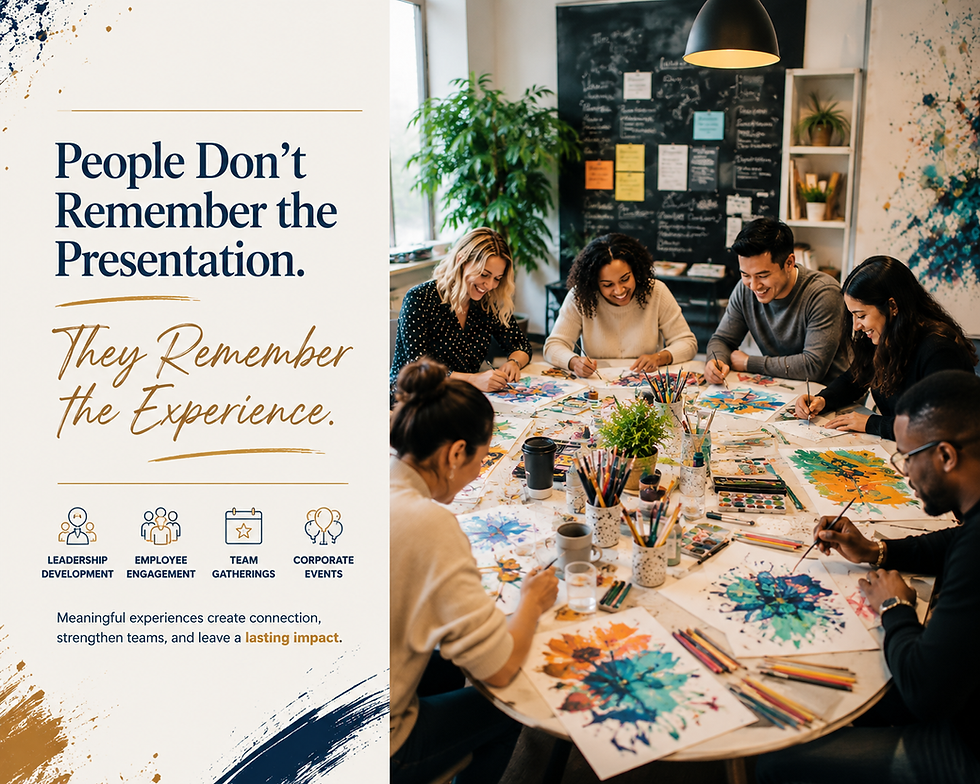
Tangible team memory. Unlike a forgettable happy hour, a creative workshop produces something real. A painting. A shared experience. A story people tell for months afterward. That kind of memory builds culture in ways spreadsheets can't capture.

C-Suite-Friendly Language to Use in Your Pitch
Here's where we get practical.
When you're presenting to leadership, try framing your request with language that resonates with their priorities:
✔ Instead of: "This would be a fun team activity." Try: "This is a low-cost intervention to address engagement and retention risk."
✔ Instead of: "People seem stressed." Try: "We're seeing early indicators of burnout that could impact Q3 productivity and turnover."
✔ Instead of: "I think it would help morale." Try: "Research shows that creative wellness experiences improve team cohesion and reduce absenteeism: both of which directly affect our bottom line."
✔ Instead of: "It's not that expensive." Try: "The investment is a fraction of what we'd spend replacing even one disengaged employee."
You don't need to hype it. Just connect the dots clearly.
How to Present Workshop Options (Without Overwhelming Them)
When you pitch, keep your options clean and scannable.
At VFA Creative Events, we offer three tiers designed to fit different team sizes and goals:
Creative Workshop Perfect for smaller teams or leadership groups. An intimate, guided experience focused on presence, connection, and creative expression.
Corporate Event Ideal for department-wide gatherings or team offsites. Scalable, engaging, and designed to create shared moments across larger groups.
Large Corporate Event (Up to 50 People) Built for company-wide retreats, all-hands meetings, or milestone celebrations. A full creative experience that brings your entire team into the same flow.
Each tier includes facilitation, all materials, and a calming, supportive environment where no artistic experience is required.
You can explore all the details here: VFA Corporate Creative Workshops
The "Why Now" Argument
Timing matters.
If your leadership asks, "Why do we need this now?": here's how to respond:
Post-layoff or restructuring? Teams need reconnection and trust-building more than ever.
Hybrid or remote? In-person creative experiences are one of the few things that can't be replicated on Zoom.
High turnover in a specific department? Proactive investment is cheaper than reactive hiring.
Annual planning season? Position it as a culture investment for the year ahead.
Coming off a big project or quarter? Frame it as a recovery and celebration moment.
There's almost always a "why now." You just have to name it.

A Simple Pitch Framework You Can Use
Here's a plug-and-play structure for your next budget conversation:
1. Name the problem. "We've seen signs of burnout and disengagement in [team/department]. Turnover in Q2 was [X%], and exit interviews mentioned lack of connection as a factor."
2. Propose the solution. "I'd like to bring in a facilitated creative wellness experience: a hands-on art workshop designed for team connection and stress relief. No experience required for participants."
3. Share the ROI framing. "Research shows these experiences reduce burnout indicators and improve retention. The cost is significantly lower than replacing even one employee."
4. Present the investment. "I'm recommending [workshop tier] at [cost]. This includes full facilitation, materials, and a calming environment designed for our team's needs."
5. Close with a clear ask. "Can we move forward with approval this week so I can secure our preferred date?"
You Already Know This Would Help
If you've read this far, you don't need convincing.
You've felt the tension in your team. You've seen the glazed eyes in meetings. You've heard the quiet frustrations.
You know that something needs to shift.
Creative wellness isn't a "nice to have." It's a strategic investment in the humans who make your company run.
And now you have the language to help your leadership see it too.
Ready to explore options for your team?
We'd love to help you find the right fit. Visit our Corporate Creative Workshops page to learn more: or reach out directly. We'll walk you through everything, answer your questions, and even help you build your internal pitch.
No pressure. Just possibility.


Comments