

Beyond the Screen: Reclaiming Physical Connection in a Hybrid World

You know that slightly hollow feeling after back-to-back Zoom calls?
The one where you've "connected" with twelve people but somehow feel more isolated than before?
That's your nervous system telling you something important.
We weren't built for this much screen time.

The Hybrid Gap No One Talks About
Hybrid work solved a lot of problems.
Flexibility. Better work-life balance. No soul-crushing commutes.
But it created a new one: the erosion of physical presence.
We gained hours in our day. We can finally make that morning yoga class or eat real lunch instead of desk snacks.
But here's what we lost:
The unplanned hallway conversation. The shared laughter over coffee. The way you could read someone's energy just by sitting next to them. The muscle memory of being with people, not just looking at them.
Your team isn't just missing connection.
They're missing embodied connection, the kind that happens when you share physical space, move together, create something tangible side-by-side.
No amount of virtual happy hours can replicate that.
Why Your Body Needs More Than Screens
Here's what the research is showing: hybrid workers are moving more, sleeping better, eating real meals instead of vending machine runs.
They're reclaiming their physical lives in beautiful ways.
But there's a paradox.
All that individual wellbeing? It's happening alone.
You're taking those morning walks solo. You're stretching between calls in your home office. You're preparing healthy meals in your own kitchen.
The body is thriving. The social nervous system is starving.
And that matters more than most companies realize.

What Hands Can Do That Screens Can't
There's something that happens when you work with your hands.
A quieting. A shift from thinking to being.
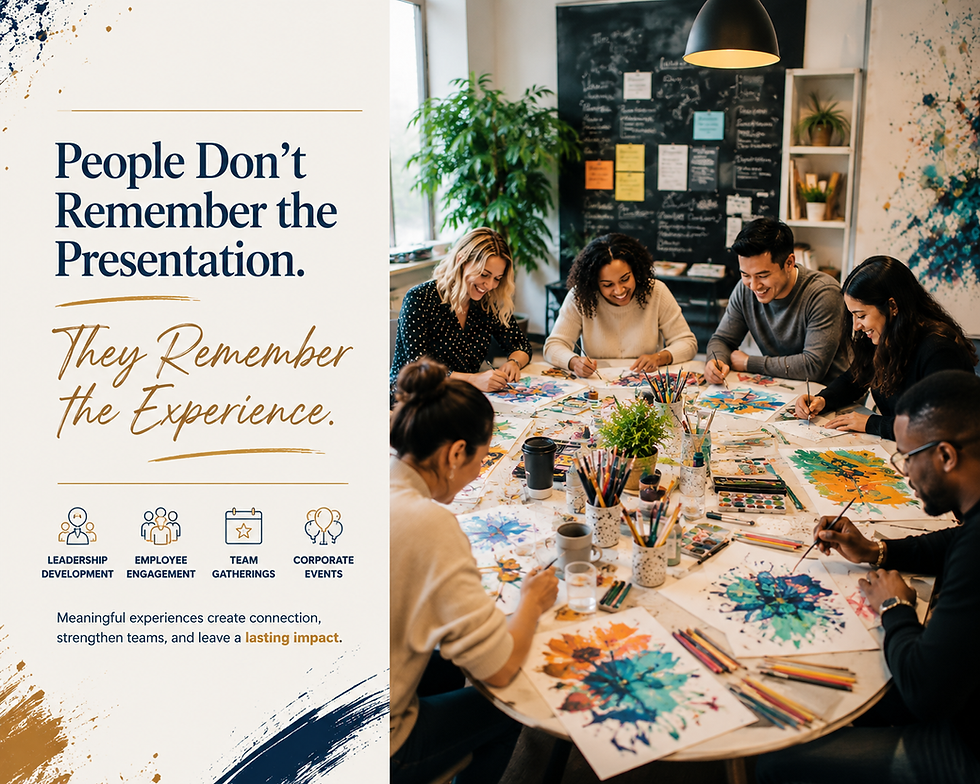
When your team sits together, not at keyboards, but at a table covered in paint and canvas, something changes.
The conversation flows differently.
People who are normally quiet in meetings suddenly have space to show up.
The overachievers can't overthink their way through abstract art.
Everyone's on the same playing field: beginners, all of us, just exploring.
This isn't about creating masterpieces.
It's about what your nervous system does when you:
Touch real materials with your actual hands
Sit shoulder-to-shoulder with colleagues in three-dimensional space
Create something messy and imperfect together
Laugh at the chaos instead of performing professionalism
Your team doesn't need another Zoom session with a facilitator teaching them breathing techniques.
They need to breathe in the same room.
The Science of Tactile Connection
When you engage in hands-on creation, your brain lights up differently than it does during screen work.
You're using different neural pathways.
Abstract painting, in particular, activates:
Fine motor skills (calming the nervous system)
Spatial reasoning (pulling you out of analytical overthinking)
Color perception (engaging emotional processing)
Non-verbal communication (the kind that builds actual trust)
And here's the magic: you're doing all of this together.
Not watching a shared screen.
Not waiting for your turn to unmute.
Actually together, in real time, in physical space.

What This Looks Like in Practice
I work with teams across Chicago and Illinois who've realized that quarterly off-site retreats aren't enough anymore.
They need rhythm. Consistent touchpoints. A pattern of reconnection.
That's why our Corporate Creative Wellbeing Programs aren't one-off events.
They're ongoing partnerships that create a cadence of presence for teams that live mostly in the digital realm.
Here's the framework:
1. Individual Focus Each person starts with their own canvas. Their own colors. Their own expression.
No collaboration pressure. No group consensus.
Just you, the materials, and permission to create without judgment.
2. Create Together Then, the magic: you start noticing what others are doing.
Someone's bold color choice inspires you.
You see a colleague take a risk, and it gives you permission to do the same.
The energy in the room shifts from isolated focus to collective flow.
3. Share Perspectives At the end, we talk. Not about the "quality" of the work, there is no right or wrong here.
We talk about what the process felt like.
What surprised you. What felt hard. What felt freeing.
And suddenly, you're having real conversations.
The kind that don't happen on Slack.
This Isn't Therapy. It's Not an Art Class.
It's something in between.
A structured space where your team can:
Show up as whole humans, not just job titles
Release the tension they've been carrying through digital fatigue
Build trust through shared vulnerability (the kind that happens when everyone's art looks "bad" together)
Remember what it feels like to be present with colleagues
No art experience required.
No performance pressure.
Just materials, guidance, and the quiet permission to be imperfect together.

The Real ROI of Physical Reconnection
Let's be practical for a second.
When your team spends 90% of their time on screens, that 10% of in-person time becomes disproportionately valuable.
Not for strategic planning. Not for presentations.
But for the kind of bonding that makes everything else work better.
Better communication. Faster problem-solving. More trust.
And yes: people actually wanting to stay at your company instead of jumping ship for another remote gig that pays $5K more.
Turnover costs you six to nine months of that person's salary.
Reclaiming physical connection costs you a quarterly workshop.
Do the math.
Moving From Transactional to Transformational
Here's the shift I see companies making:
From: Annual team-building events that feel forced and forgettable
To: Quarterly creative wellbeing rhythms that become something your team actually looks forward to
From: "We did the thing, check the box"
To: "When's the next session? I need that reset."
It's not about adding more to your calendar.
It's about replacing what doesn't work with what actually nourishes your people.
You Don't Have to Figure This Out Alone
If your team is spending most of their time in the hybrid blur: some days together, most days apart, always a little disconnected: you're not imagining it.
That gap is real.
And filling it doesn't require another trust fall or escape room.
It requires creating space for your people to slow down, use their hands, and remember what it feels like to be human together.
We bring everything to you: mobile workshops across Chicago and Illinois that meet your team where they are.
Quarterly programs. Semi-annual rhythms. Annual signature experiences.
Whatever cadence supports your people best.
Explore our corporate creative wellbeing offerings here.
Or just reach out. Let's talk about what your team actually needs: not what the team-building industry says you should buy.
Because at the end of the day?
Your people don't need another Zoom link.
They need to put their hands in paint and remember they're alive.

Comments