

People Don't Remember the Presentation. They Remember the Experience.

Organizations invest significant time and resources into leadership development, employee engagement initiatives, conferences, retreats, and corporate events.
The goal is often the same:
Help people learn.
Help teams connect.
Help employees feel engaged and motivated.
Yet a simple question is worth asking:
How much of a presentation do people actually remember six months later?
Most of us have attended countless meetings, workshops, and training sessions throughout our careers. We may remember a few slides, a statistic, or a quote. But those details tend to fade surprisingly quickly.
What often stays with us is something else entirely.
We remember how we felt.
We remember the conversation that happened during a break.
We remember the colleague we connected with for the first time.
We remember laughing together.
We remember feeling seen, included, relaxed, or inspired.
In other words, people often remember the experience long after they forget the content.
This matters because organizations today are facing challenges that information alone cannot solve.
Employee burnout remains a concern across industries.
Many teams are navigating constant change, increasing workloads, hybrid work environments, and communication fatigue.
Employees spend much of their day moving from one meeting to the next, processing information, solving problems, and responding to requests.
What many people are missing is not information.
It is meaningful human connection.
This is one reason employee engagement efforts are evolving.
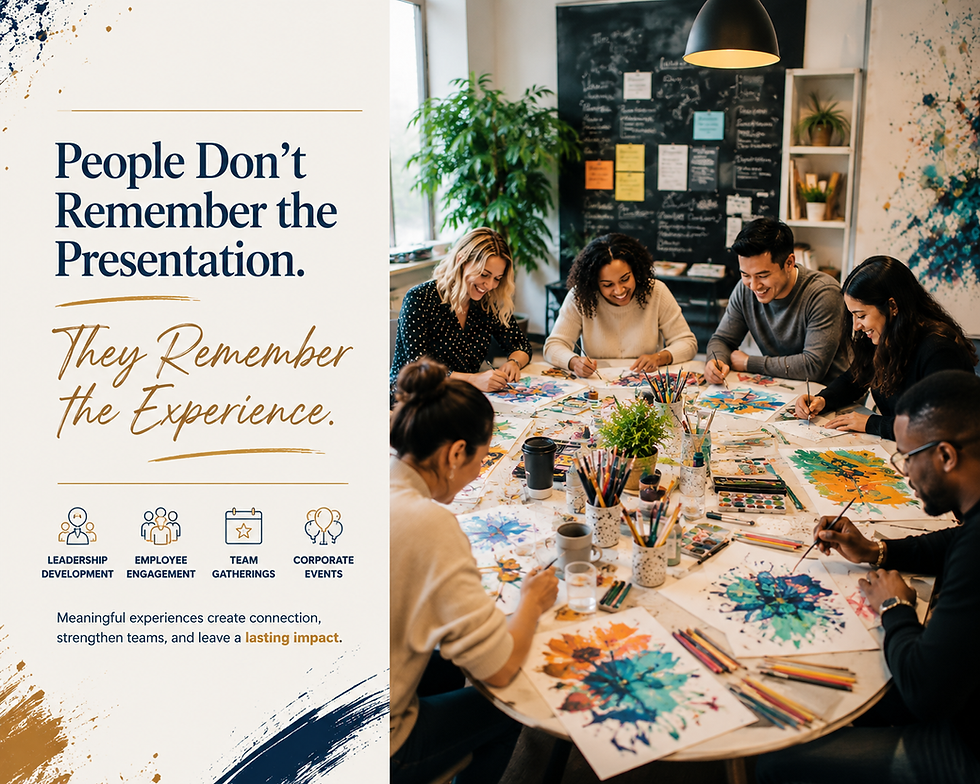
Organizations are beginning to recognize that engagement is not created through announcements or presentations alone. It is built through shared experiences that help people interact differently and strengthen relationships.
The same is true for leadership development.
Leadership is not simply the transfer of knowledge.
It is the ability to build trust, foster collaboration, communicate effectively, and create environments where people feel connected and valued.
These qualities grow through experience.
Not just information.
This shift is particularly relevant for technology teams, finance professionals, and other high-performing corporate environments.
Many employees spend their days in analytical mode, solving complex challenges and managing demanding workloads.
Creating opportunities for people to step outside that mode, even briefly, can have a surprisingly powerful impact on team dynamics.
When people engage in a shared creative experience, something different happens.
Titles matter less.
Hierarchy softens.
Conversations become more natural.
People see one another as human beings rather than simply coworkers.
Those moments may seem small, but they often become the moments people remember.
Months later, employees rarely talk about a slide deck.
They talk about the experience they shared together.
That is why more organizations are looking beyond traditional event formats and searching for ways to create meaningful experiences that support connection, wellbeing, and engagement.
Because people may forget the presentation.
But they rarely forget how an experience made them feel.
Victoria Isikman
Chicago Corporate Events, Employee Engagement & Creative Team Experiences



keonhacai5 mình thấy dạo này nhiều người nhắc nên cũng tò mò bấm vào thử cho biết. Mình không có ngồi soi nội dung hay chơi gì cả, chủ yếu xem giao diện họ làm thế nào thôi. Ấn tượng đầu là bố cục nhìn khá thoáng, các mục được gom theo nhóm nên lướt một vòng là hiểu mình đang ở đâu. Mình thích kiểu họ trình bày thông tin theo dạng khối và bảng cột gọn gàng, nhìn nhanh không bị rối mắt như vài chỗ khác. Menu cũng đặt chỗ dễ thấy nên chuyển qua lại giữa các trang khá mượt, không phải bấm tìm nhiều. Nói chung cảm giác dùng thử vài phút khá dễ chịu,…
Bài viết rất rõ ràng, dễ hiểu, cảm ơn bạn đã chia sẻ. Mình cũng hay theo dõi mảng giải trí trực tuyến, thường để ý cách họ bố trí giao diện và chia mục hơn là soi từng trò. Để tiện xem lại sau này, mình tự gom và lưu một vài chỗ trên một trang riêng để khỏi phải tìm lại nhiều lần. Ai quan tâm thì ghé https://www.activewin.com/awin/user_archived.html?Action=Read&UserIndex=135679