

Creative Team Building Ideas for Burned-Out Teams

Burnout rarely shows up all at once. It sneaks in quietly. A little less energy during meetings. Cameras are staying off longer on Zoom calls. Conversations becoming purely transactional. Teams still “function,” but something human starts to fade beneath the deadlines and notifications.
Many companies try to solve burnout with another presentation, another productivity framework, or another meeting about communication. But exhausted teams usually don’t need more pressure to perform. They need space to reconnect with themselves and with each other in a way that feels natural.
That’s where creative team experiences can make a real difference.
Not because everyone suddenly becomes an artist. And not because painting a canvas magically fixes workplace stress. The value comes from creating an environment where people can pause, interact differently, and experience one another outside their job titles.
One of the biggest mistakes companies make when planning team-building activities is choosing experiences that feel forced. Employees can tell immediately when an activity is designed only to “boost morale.” If it feels artificial, participation drops fast.
The best creative team-building activities are low-pressure, engaging, and structured in a way that allows people to contribute without feeling judged.
Here are a few formats that tend to work especially well for burned-out teams:

Collaborative Canvas Sessions
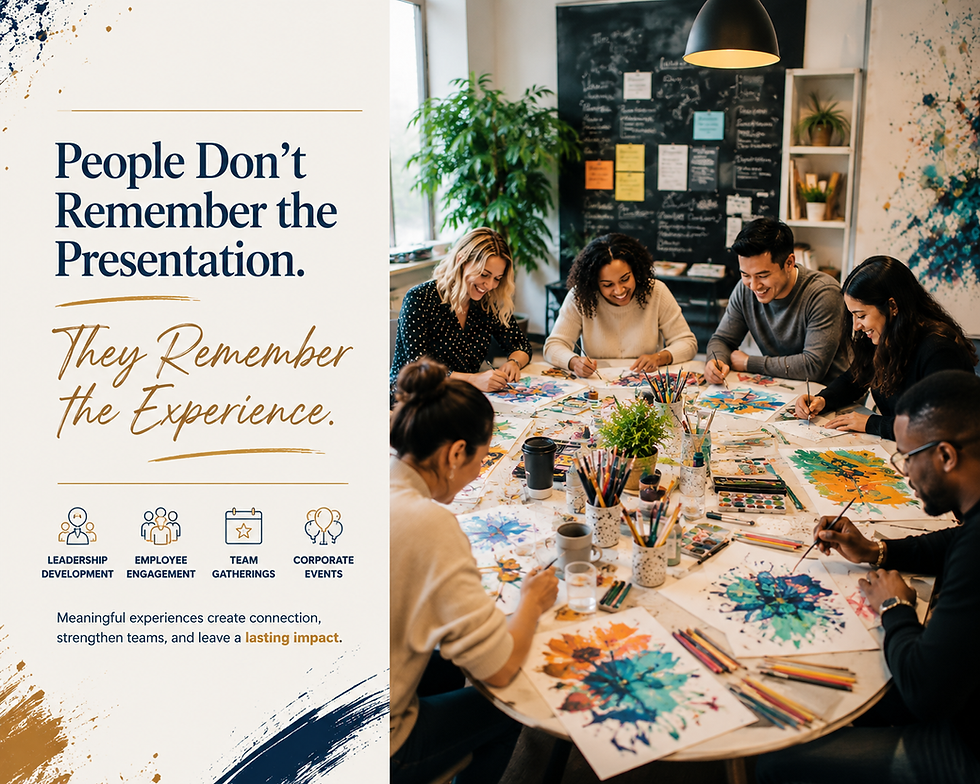
A shared canvas changes group dynamics surprisingly quickly. Instead of discussing quarterly goals or solving problems verbally, team members contribute visually together. Some people paint boldly. Others add small details quietly over time. The result becomes less about artistic skill and more about participation and presence.
These sessions work especially well for teams experiencing communication fatigue because they create interaction without requiring constant talking.
Guided Creative Reflection Workshops
Burnout often disconnects employees from their own emotional awareness. Guided creative reflection activities can help teams slow down and process stress in a healthier way.
Simple prompts like:
“What does calm look like to you?”
“What shape represents your current workload?”
“What would balance feel like visually?”
…can open conversations more naturally than traditional icebreakers ever do.
Creative Reset Stations at Conferences or Retreats
Long conferences can drain attention fast. A quiet creative station where attendees can sketch, collage, paint, or contribute to a collective artwork offers a mental reset that feels restorative instead of performative.
People often stay longer than expected because creativity gives the brain a different rhythm. It interrupts the constant analytical mode that many professionals stay trapped in all day.
Team Murals
Murals are especially effective for departments recovering from high-stress seasons, mergers, leadership changes, or restructuring. Creating something large together helps rebuild shared identity in a subtle but powerful way.
The interesting part is that the conversations happening around the artwork often matter more than the artwork itself.
One person mixes colors while another talks about parenting stress. Someone laughs for the first time all week. Another finally speaks to a coworker they’ve barely interacted with despite working together for years.
That’s the real shift.
Creative activities also work because they temporarily remove hierarchy. During a collaborative workshop, the CEO and the intern are simply two people adding paint to the same surface. That dynamic creates a kind of psychological breathing room that’s hard to replicate in traditional corporate environments.
Of course, creative team building is not a replacement for healthy leadership, manageable workloads, or proper organizational support. Burnout cannot be solved with one workshop. But meaningful creative experiences can help teams reconnect emotionally, reduce stress, and remember what collaboration actually feels like when it’s not tied directly to output.
And in many workplaces today, that alone is valuable.
Victoria Derin Isikman


Comments